Recognition
It means a great deal to us that alumni and friends choose to support Trinity Hall. In recognition of this, we have established events and groups to thank you.
Recognition groups
Master’s Circle
This College group is for those donors who have given over £50,000 cumulatively. Members of the Master’s Circle are invited for a dinner with the Master and Fellows each year as well as to various other donor events.
The College is honoured to list the following alumni and friends as members of the Master’s Circle:
- Edgar Allen (1994)
- Sarah Bates (1977)
- Steve Bates (1976)
- Tim Bunting (1982)
- Nigel Chancellor (1990)
- David Cleevely (1978)
- George Cooper (1960)
- Tom Crawley
- Richard Devitt (1959)
- Darrin Disley (1991)
- Michael Eddershaw (1959)
- Paul ffolkes Davis
- Aristos Galatopoulos (1985)
- John Gale (1976)
- Alastair Graham (1972)
- Chris Grigg (1978)
- Fionna Grigg (1978)
- Stephen Hale (1960)
- Nick Heesom (1964)
- Michael Horton (1957)
- Stephen Kinsella (1979)
- Jonathan Klein (1979)
- Evangelos Kotsovinos (2001)
- Pat Lansdell
- Aaron Lee (1993)
- Helen Lee
- Steven McTiernan (1969)
- Paul Orchard-Lisle (1958)
- Michael Orr (1957)
- Jeremy Parr (1980)
- Jim Passamano (1998)
- Nick Patterson (1965)
- Winston Poon (1972)
- Priyansha Raina
- Revvity Foundation
- Colin Rimer (1963)
- Peter Roussak (1978)
- Krishnan Sadasivam (1988)
- Jason Sippel (1988)
- Jim Taylor (1960)
- Nigel Thomas
- Gary Thornton (1987)
- Margaret Thouless
- Edward Wilde (1961)
- +11 anonymous donors
Bateman Benefactors
This College group is for those donors who have given over £500,000 cumulatively to the College. Members of this group receive extended College dining rights, including an invitation to the College’s annual Bateman Feast in May and are presented with a silver set of Trinity Hall cufflinks or a Trinity Hall scarf pin.
The College is honoured to list the following alumni and friends as Bateman Benefactors:
- Gaenor Bagley (1983)
- Peter Bagley (1983)
- Leslie Chung of the Philomathia Foundation
- Wilfred Chung of the Philomathia Foundation
- Iain Drayton (1991)
- Susan Littlefield
- Frank E. Morgan II (1974)
- Martin Roper (1982)
- Graham Ross Russell (1953)
- Jean Ross Russell
- Evan Schulman
- Rosemary Scott
- Walter Scott (1969)
- Hugh Taylor (1962)
- The Underwood Trust
- Natasha Wong of the Avery Tsui Foundation
- Sally WongAvery of the Avery Tsui Foundation
- The WYNG Foundation
- + 1 anonymous donor
1350 Society
The 1350 Society recognises and thanks all those who have remembered Trinity Hall in their Will. As a member, you will receive an invitation to an annual special event and to the Supporters’ Garden Party, a 1350 Society pin, be thanked in the Donor List every year (unless you wish to remain anonymous) and receive special reports and updates.
The Society was launched in 2009 and we have over 240 members, who have together pledged more than £21 million in their Wills to the College. Generosity at this level is truly transformational, and will ensure we are able to offer all the benefits of a Trinity Hall education for future generations regardless of their means or financial circumstances.
Benefactor Fellows
Exceptional philanthropy may be recognised by nomination to a Benefactor Fellow, subject to Governing Body approval, which offers enhanced dining privileges.

Events
Supporters’ Garden Party
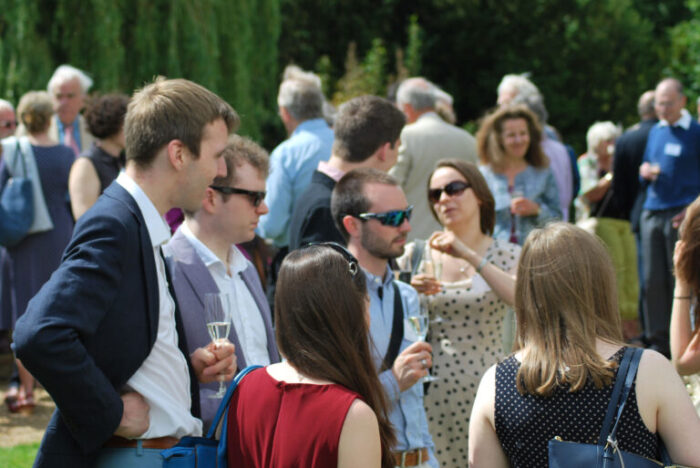
All members of the 1350 Society (Legators), volunteers, those who have made a donation of at least £250 in the previous financial year, and anyone under the age of 25 years who has made a donation in the previous financial year is invited to this annual summer event.
Donors are listed in the annual newsletter of the College, the Trinity Hall Review, unless they wish to remain anonymous.
Commemoration of Benefactors
We also recognise and celebrate long-term and recurring support. Each year, on the first Sunday in February, we invite donors who have given more than £10,000 to the College, or who have reached their tenth consecutive year of giving, to our annual Commemoration of Benefactors.
The occasion includes a service of thanksgiving in Chapel, followed by dinner in Hall, providing an opportunity to thank our supporters for their commitment to Trinity Hall.
2026 Commemoration of Benefactors address by The Revd Professor David Wilkinson, in the Department of Theology and Religion at Durham University
I am thankful to the Master and to the Dean for this invitation to participate in this service. My friendship with Dr Plant both in theological circles and most importantly on the cricket field has been a delight over the years.
I also owe much to a previous Dean and chaplain, Rev Dr John Polkinghorne, who was my friend and mentor in the area of the relationship of science and Christian faith. Having worked on his biography for the Royal Society I know just how important this College was in his journey from the Cavendish, through parish duties and then back into the arena of theology.
Last week I was at Caltech and NASA’s Jet Propulsion Lab in Pasadena speaking about science and the Christian faith. I was overwhelmed by so many scientists wanting to engage in questions such as the origin and end of the universe, SETI, and AI.
Within these big questions which science poses was a deeper question about the funding of science with the Trump administration squeezing NASA funding in many areas and Caltech and other universities worried that endowments could be taxed. Even in the rarefied arena of science, money is key.
While I was in Pasadena I couldn’t help notice another effect of Donald Trump which was in one of the local shops – a range of Donald Trump Valentine cards appearing Under the campaign slogan, ‘Make America date again’. There were pictures of Donald Trump with lines such as ‘I love you like Trump loves Trump’, ‘You may have seen me with someone else but my love for you is an alternative fact’, ‘I love you more than an executive order’ and ‘You have the highest approval rating of any boyfriend ever. Really tremendous. Totally the best in the whole history of boyfriends. Other boyfriends? Losers. Believe me. Everyone agrees.’
Of course what those cards do is to use cultural references to make you think, laugh and direct your attention to other things. Stories and jokes do that. Now they don’t work for everyone and some don’t get the reference. Some find themselves trying to work out the meaning – is he having a go at Trump or is he just telling a few jokes at the beginning of a sermon?
When Jesus tells parables some are really clear others are more difficult both to understand and to come to terms with. In Matthew’s gospel a clear parable is the kingdom of heaven is like a mustard seed, the smallest of all seeds, which becomes the greatest of shrubs. However this parable, which we heard read from Matthew 25, has some difficulties. It is part of the fifth and last of the great discourses or collections of Jesus’s teaching, grouped around the theme of the future and judgement. Within this great discourse this parable is a sub section, part of private teaching to the disciples 24:3.
The easy interpretation is that Jesus is the Master, he is going ahead and leaving his disciples gifts. Then we are all going to be called to account for what we have done with these gifts. But… first the Master is a complicated character, going off to another country, owning slaves, some didn’t like him and he was a ‘harsh man’ (v22) throwing the slave into outer darkness for being timid. This is not a good picture for a loving God! Second, are we being asked to follow this pattern? That is those with power and money get more of it? The biblical scholar Elizabeth Dowling notes the outrageous profits and argues that it is a story about the use and abuse of power. The parable is a story of those who suffer adverse consequences when they oppose unjust power structures. They ‘lose their pound’ when they challenge an oppressive structure, where ‘pound’ becomes a metaphor for what one has that can be potentially taken away by those in a position of power. The hero therefore
is not the person who makes a lot of money but the one who refuses to participate in the corrupt capitalism.
Now it may be that Jesus used similar stories for different purposes. Certainly this parable’s setting in Luke’s gospel may give it this sense of a critique of power. However the setting here in Matthew’s gospel is different. It is preceded by a parable of ten bridesmaids and the need to be ready for the Lord’s coming. Here readiness is not a matter of passive waiting but an opportunity to action, indeed risky action.
My suggestion is that this is probably a story which was well known. In the Roman colonial system you would go to Rome to get power. Herod the Great for example went to Rome to get power in Judea, Samaria and Galilee. Jesus is using a well known story to talk about a different kind of power and the exercise of gifts and responsibility.
The sums entrusted to the slaves are huge and different sums are given to different people – a recognition of how life gives different opportunities. This is a reality of life and we have to live within this reality. As that great prophet Peter Parker’s Uncle Ben says to the Young Spiderman ‘with great power comes great responsibility’.
However in this reality, the third servant in the words of New Testament commentator RT France substituted ‘security for service’. Or as Schweizer commented often the practice of Christian discipleship is playing safe and so achieving nothing, ‘a religion concerned only with not doing anything wrong’.
Yet being ready following Jesus consists not only of keeping your slate clean but in active responsible, faithful service which involves taking risks. There is another context for this parable in Matthew’s gospel. It is immediately followed by the parable of sheep and goats, where Jesus commends care for the hungry, thirsty, stranger, poor and imprisoned. The gifts we have been given are for truth, justice and healing – the challenge here is whether we bury our heads in the sand or take risks in making the world a better place.
So here in this wonderful educational setting of the College and University do we see the gift of science. Much discussion about AI has been about Terminator doom through to loss of jobs Some say we should have nothing to do with it. It certainly has important ethical and socioeconomic questions. But I find this parable challenges critiques for me the error that AI has the potential for good and we didn’t use it because we were too scared.
And what about the gift of this College? Today, we give thanks for the benefactors. It was founded in 1350 by Bishop Bateman, originally for the study of canon and civil law -created to train clergymen in canon law, helping to rebuild the priesthood after the Black Death. Bateman himself spent much time not only writing about canon law, but travelling attempting to bring peace between nations, a risky thing to do and there would have been those who would have warned him about faith getting involved in politics and security in life would be much better if he just stayed in Cambridge teaching canon Law!
May I gently remind you of the gift that you have been given A College which contributes to cancer care, quantum gravity, affective Intelligence and robotics, augmented reality, next generation solar cells and LEDs. The website banner ‘Together you can change the world’.
And what about the gift of nation? There are some who want to see nationhood in terms of power, making us great again, extending that power over other nations or at the expense of other nations. There are those who see political office for personal gain rather than service. Yet through this latter section of Matthew, the future of Israel and the Temple are entwined. Remember the gifts that we receive are to be used for the Kingdom of God to feed the hungry, to care for the poor, welcome the stranger, to free those imprisoned by life circumstances. A truly great nation is not defined by its military or economic power but by whether it uses its power as a servant for peace and justice.
Some time ago the final question on an edition of Radio 4’s Any Questions was ‘how do you view old age’ One panellist said I want to do everything to resist it, to fight against it and I will be more grumpy and objectionable. However another panel member, John Habgood, the Archbishop of York, commented that getting old was a reminder that all is gift. Getting up a flight of stairs which he did without thinking about it now takes time, and this was a reminder of the gifts that as a younger person he took for granted. He saw getting old as giving back to God all of the gifts of life that he had received.
40 years ago I graduated as a physicist and in my college cohort 25 of us met up recently to celebrate that we were still alive! Our convenor in his speech took us back to the College grace which ‘he put up with each week’ but now means so much more to him.
Bless, O Lord, us and your gifts, which from your bounty we are about to receive, and grant that, healthily nourished by them, we may render you due obedience, through Christ our Lord.
2025 Commemoration of Benefactors address by His Excellency Archbishop Miguel Maury Buendía, Apostolic Nuncio in Great Britain
Dear brothers and sisters, I am very pleased to be present this evening as you celebrate this Commemoration of Founder and Benefactor’s service. I am grateful to the Reverend Dr Stephen Plant for the invitation to preach, and to the Master, Mary Hockaday, for the kind welcome.
To each participant at this Evensong, and all the students and staff of Trinity Hall, I bring the blessing and greetings of Pope Francis. Please keep him in your prayers, too!
It is a particular honour to mark this occasion, considering the diplomatic role played by the founder of your College on behalf of the Pope in the fourteenth century. As you well know, on more than one occasion, Bishop William Bateman served as Papal Legate, working for reconciliation between England and France – thankfully not a work I have had to do myself! His founding of this College was also in service to the Church: to train clergy after the devastation of the Black Death. This is a legacy to celebrate! It is good for us to remember our Christian heritage, to learn from the mistakes of our past, and to celebrate faith in Christ for the formation of the spiritual, cultural and political life of this continent over the centuries.
A similar message comes from the prophet Isaiah, which we have just heard in the First Lesson. The prophet calls Israel to “look to the rock from which you were cut”. God’s people are encouraged to remember the blessings of the past in order to better understand the present and to have hope for the future. The Israelites are here offered a message of encouragement during their time of exile: that just as God has been with them in the past, so too will he lead them forward to a new life.
We stand on the shoulders of those who have gone before us, and we impoverish ourselves if we forget our identity. It is also our responsibility to make use of the gifts God has given us in order to build a better future for those who will come after us. This is the message Jesus gives in the Gospel passage from Matthew: the parable of the talents. We all have God-given talents, and we are called to use them, not to bury them in the ground. Pope St Gregory the Great (Forty Gospel Homilies, 9.1), commenting on this passage, observes that to bury the talent means to use it only for myself, for earthly gain. Instead, the Lord invites us to be fruitful: to be creative, passionate and intelligent in contributing to the greater good of our neighbours.
Pope Francis, in establishing this Jubilee Year of 2025, has emphasised in particular the importance of hope. Reflecting on the role that the formation of young people has in creating a better future, the Holy Father noted that:
“Education is, above all, an act of hope in those before us (…), in their possibilities to change and contribute to the renewal of society. The creation of relationships of justice among peoples, the capacity for solidarity towards the needy, and the care of the common home will pass through the hearts, minds, and hands of those who are being educated today.” (Pope Francis, Message to Catholic Educators Conference, February 2024)
In celebrating the Foundation of this College, let us pray that we might use the gifts that God has given us for the betterment of those around us. We entrust ourselves to the intercession of Our Blessed Mother that we may truly be “Pilgrims of Hope”, rooted in our Christian identity to make known to the world the joyful message that Christ brings. Amen.
2024 Commemoration of Benefactors address by The Rt Rev Christopher Foster (1977), former Bishop of Portsmouth
We are here tonight to rejoice. Though the formal title of this service calls us together to commemorate, our service is punctuated with expressions in word and music of celebration, thanksgiving, and rejoicing. There is much for which to express our gratitude by recalling the generosity of our founder and our benefactors down the generations, and right until today.
So I echo the exhortation of the letter to the Philippians in urging us to rejoice this evening, in Chapel and afterwards, as well as commemorate. There is not much dispute, as you may know, of the hand of Paul himself in this letter albeit that the text we have is probably a compilation of snippets of several letters of gratitude and affection from a prison cell. The verses we heard are preceded by Paul writing of his admiration and gratitude for specific named men and women who have, in his words, been co-workers for the gospel. And immediately after our passage tonight are further words of thankfulness for the gifts, both of money and of solidarity that the Philippians as a whole gave him.
Gifts are the context for Paul’s rejoicing as they are for ours. We rejoice in the gifts of many, named and remembered, many unknown, forgotten now or anonymous, who have generously enriched the life of Trinity Hall.
This weekend marks the end of the Christmas season. On Friday evening when I was in Blackburn Cathedral, three Christmas trees were still in place, decorated and illuminated. That’s an unlikely reality to those who celebrated Christmas at a carol service here at the start of December. But Candlemas on 2nd February is the traditional time to remove the tree and the crib at which for the last month the magi have been present with their gifts for the baby Jesus. These, and every present we give involve the risk, the generous risk, of passing something of value from our hands into the control of the ones receiving it. Once delivered the donor entrusts it to the care and use of the recipient. Of course we are all aware that some gifts to this college have been made with ‘strings attached’ and a clear understanding of the use to which they will be put. But it remains true that a gift always involves letting go of something which we hold and control, and passing it into the care and stewardship of others. It is not just what has been gifted to us in Trinity Hall which we celebrate, but how it has been given with generosity and with empty open hands.
Giving to this College, or to any charity or religious group or organisation, involves rather more than giving a present to a friend or family member. Those we honour in this service chose to be generous not to an individual but to the college and for the common good. Jesus’ metaphor of himself as the vine spoke to his disciples of their connectedness to him and to each other. That’s a strong image for a community like Trinity Hall where our belonging and our reliance on each other, at any one time and down the generations, is central to our understanding of who we are. I dare to suggest, but with confidence, that this has been and is important to those whom we remember. Jesus tells his disciples that their belonging as branches in him, the true vine, is essential; “apart from me you can do nothing.” In this community we know that belonging, in our variety and in our difference, connectedness, is critical to our flourishing.
And not only our individual wellbeing and the good of the Hall. The bidding for this service speaks of the needs of this college and of the wider world. We seek not a sectional, special or selfish interest but for the generosity and commitment of benefactors to enable learning and study, research and discovery, friendship and fellowship to be used for the common good and the benefit of all people, for society and the world. Elsewhere in the letter to Philippians we read of divine generosity as God empties himself to take the form of a human servant in the person of Jesus Christ. That costly willingness to let go of everything, as exemplified in the life and death of Jesus Christ is seen mirrored, at least in part, in those we honour today letting go and giving away possessions, money, privileges and benefits.
That invites us not only to gratitude and rejoicing, but also enquires about how we will use the benefits we enjoy. “Whatever is true, honourable, just, pure, pleasing, commendable, if there is anything worthy of praise, think about these things.”
Commemoration and rejoicing prompt us to think, to reflect, and consider for ourselves how our lives and giving reflect eternal verities.
2023 Commemoration of Benefactors address by The Rt Revd Graham Usher, Bishop of Norwich
1 Peter 2.4-10 & Matthew 25.14-30
A college like this relies on a great many gifts. We come together tonight with thankful hearts for the benefactors down the years who have generously given, and continue to give, to the Hall so that others might flourish. But an institution like this does not rely just on financial gifts. A whole series of other gifts enable this place to flourish.
Stretching over a history of 673 years, there are countless men and women, whose names we no longer recall, who have built and laboured, cleaned and polished, cooked and served, sweated and toiled for the good of this place.
There are also those students who have had few opportunities, and come from communities where this is such an alien place, who have brought a new dimension to your common life.
There have been those who have used every opportunity whilst here to be inquisitive in their books and learning, and others with a great interest in the inner dynamic flow of emptying a pint of Greene King!
And there are those who have brought their teaching skills, their administrative and stewardship abilities, those who lock themselves away and those who enjoy a party.
Each has had the potential to bring something to your life together and so enrich the experience of other people here.
For a community to flourish it relies on a great many gifts.
So we come to this chapel tonight to give thanks for all of those gifts through time. For this place is filled with the gift of living stones, the people seeking God through baptismal lives, in the scriptures, in the silence of prayer, in bread and wine, as we build community together. Make the door of this place wide enough to receive all who need human love and friendship, but narrow enough to shut out all malice, guile, insincerity, envy and slander.
William Bateman knew more than anyone that the church is not its buildings but its people. Unlike other colleges founded by an unpopular king, or a racing fanatic, a war time Prime Minister or a guilt-ridden nun, you were founded by an astute church politician; the papal envoy between the English royal court and the Papal court based in Avignon during Edward III’s wars with France. Bateman was sometime Dean of Lincoln and excommunicator of errant clergy. During the time of the Black Death he was a distant predecessor of mine as Bishop of Norwich.
The Norwich Book of Pleas described these years: ‘In the year of our Lord 1349, God Almighty visited mankind with a deadly plague . . . in many places this plague did not leave the fifth part of the people alive, it struck the world with great fear, so great was the pestilence, that the like was never seen, heard, nor read of before’. Records show that more than 2000 of William Bateman’s clergy died during that period of pandemic. The annual average number of institutions of clergy to parishes in the Diocese of Norwich for the five years from the Lady-days of 1344 and 1349 had been 81. During the year ending Lady-day 1350 the number increased over ten-fold to 831.
In an extraordinary affirmation of confidence in the future, the founding of this Hall was Bateman’s response to that disaster. He needed to train clergy. Naming it Trinity Hall ensured he covered all bases of the triune God’s patronage and protection! To quote the Founder’s wishes, this was a long-term investment in, “the promotion of divine worship and of canon and civil science and direction of the commonwealth and especially of our church and diocese of Norwich.” So, I’m looking out tonight for people to ordain and serve the Diocese of Norwich!
And into this community tonight we hear afresh Jesus speaking a parable about talents. Sermons about this parable seem to me to fall into two types. There are those sermons that basically go like this,
You here at Trinity Hall have much money as an institution, and have the potential as individuals to accrue much wealth in your lives, go and use it to make more money so that the more you pile up the more you can give away. Remember there are no pockets in shrouds.
The parable is about money and generosity.
The second category of sermon goes like this,
You here at Trinity Hall have so many gifts. As an institution and as individuals you are five-talented gifted, for goodness sake use those gifts in the service of others, both now and in what ever the future holds for you.
The parable is about the gifts we have and how we use them.
Sat here it is very easy to hear these interpretations. We like to be told we are gifted and we like the thought of making more money. The trouble is that this is what we hear. Might Jesus be saying something else? What if he was referring to himself as the owner of the property who is going away but will come back, and the slaves are his disciples? Jesus is soon to leave his disciples and will leave everything he has done and begun in their care. What will they make of it all? What will we do with it all?
Parables often contain wild exaggerations. A talent was a huge sum of money, perhaps 20 years’ worth of wages so even the slave with just one talent was weighed down literally by the cash. It was far more than enough. The only people who had that kind of money were the wealthy elite.
The disciples were given immense gifts. They all had the one talent. Might this be sharing in his baptism, of reading the scriptures, of learning to pray, of meeting him in bread and wine? For others, they also were given gifts of teaching and healing, of prophesy and speak in tongues, of bringing reconciliation and offering forgiveness. It is a total mystery as to who receives which.
Each have spent much time in an apprenticeship with Jesus. The more they do as he did, the more they begin to look like him, using their hands to bless, to heal, to break, to touch, to pray. The more they imitate Jesus the more successful they are.
But on Jesus’ return the third slave who has perhaps been given the gifts we all receive – a share in baptism, attending to the scriptures, a way of prayer, a eucharistic joy – has done nothing with them. Jesus is perplexed.
Did you not realise that in baptism we take on a new way of being and put away the things that destroy us?
Did you not realise that when we open the scriptures, even in their multiple voices and contradictions, we discover the God who loves us?
Did you not realise that in prayer we find our daily bread, the forgiveness of sins and our ability to forgive others?
Did you not realise that in the breaking of bread we find a common home where everyone, sinner and saint, is equally welcome?
The third slave panics and makes us a story of a cruel master. And this is the great shock in the parable. How could Jesus be taken to be a cruel and merciless absentee master?
These slaves have seen him turn water into wine, pick ears of corn on the Sabbath, and sewn seeds wherever he went, even on stony and thistly ground, seen the generosity of his invitation to sit and eat, and they have witnessed him invited everyone he encountered to live a Kingdom life.
The blind have literally seen it and the lame have danced about it.
And yet the disciples have missed the opportunity to be like him.
You see this parable is not about you or me. Its focus is on Jesus and the life he offers us.
Jesus isn’t primarily waiting to see how you use your money to make more money, or whether you use your gifts properly.
Jesus wants you and me to know first and foremost of his abundant offering in your life. When we recognise him, not as some cruel task-master, but a person of abundant generosity, so we experience a new dimension to life. We will want to look and live more like him; to be a community that looks and lives more like him.
You see, the Gospel is not something of scarcity but abundance and the parables of Jesus always show us the heart of God. There is so much God, so much kingdom, so much he wants to give us. Far more than we ever, ever imagine or need.
Today we give thanks for all of that, and all who have woven something of Jesus’ abundant life as living stones within the history of this College.
The author is grateful for work by Walter Brueggemann and Sam Wells that have influenced his reading of Matthew 25.14-30.
2022 Commemoration of Benefactors address by The Revd Professor David Fergusson OBE FBA FRSE
Home is where one starts from’ says T S Eliot in East Coker, one of the Four Quartets. That seems a reasonable assumption, though for most of us a home is much more than that. Not only a point of departure, home is a place of return and arrival, even of longing and hope. The expression ‘homeward bound’ has a reassuring feel; so does ‘keep the home fires burning’, the title of Ivor Novello’s best known song from the First World War.
There’s a silver lining
Through the dark clouds shining,
Turn the dark cloud inside out
Till the boys come home.
And note how estate agents use the deeper resonances of ‘home’ to market the houses they sell. Homes that match. Where dreams come home. Be Home, which seems to be missing something but perhaps that’s the point.
The reading from Deuteronomy 8 speaks of a people in the wilderness seeking a homeland, a place flowing with milk and honey. But their prosperity depends not just on arrival at their destination but on maintaining a set of laws that will order their common and religious life. These function like house rules for their welfare and the right administration of their affairs. Often, they fail to adhere to it. In the New Testament passage which deals with disunity and dissension, Paul employs the metaphor of a building for the church. It will stand as long it is built on the right foundation, namely Christ. Later Paul compares the church to a body, the health of which depends on the proper functioning of all its parts. Today as we mark Founder’s Day at Trinity Hall, we might ponder the ways in which a college offers a home to those who live and work in it. The functions of an institution of learning seem obvious – the facilitation of research, teaching, and learning, and assessment, resulting in the production of graduates at different levels across a range of subjects. But when we consider what actually happens over and above all this, we quickly realise that a college has a purpose that is much more than this functional description might suggest. The sharing of meals, participation in sports clubs, social activities, and weekly worship, the stewardship of libraries, gardens, wine cellars and buildings, the maintenance of relations with former students, and that wider commitment to ensuring that knowledge is useful, enriching and just in its acquisition and application – all of this absorbs our attention and energies year on year.
Having taught in universities for over thirty years, I now have the privileging of corresponding with several generations of former students. And though they complain about my failure to appear on Facebook, I’ve had the opportunity of attending numerous reunions. As I hear former students reminisce, I’m often struck by how little is said about lectures, essays and exams, apart from the occasional anecdote. More is spoken about the friendships formed, social events, study trips to distant places, the quirky characteristics of teachers and other students, and the life stories of one’s peer group. One of my former students often features on TV and radio nowadays – he once said that while listening to my lecture he abandoned his vocation to become a vicar and instead decided to try his hand at comedy. I’ve never been quite sure what it was I said, but these are the surprises that punctuate a career in teaching.
The regular features of college life bear some resemblance to what is meant by a home – a place of formation, companionship, support, and the negotiation of difference. The teachers we cherish are usually the ones that took an interest in us, older people who believed in us at a time when we doubted ourselves. They gave us confidence and self-esteem as we moved forward. And this is what a home at its best does for its younger generation.
It has been remarked that a home is neither a hotel nor a prison. A hotel is more functional. We pass through and quickly forget its distinctive features. We do not usually become attached or remain for any length of time in a hotel. Downtown hotels in particular seem rather similar and indistinguishable. While these may be comfortable and afford rest, they are only a temporary staging post. They may vary in quality and price, but there’s a sameness about them, is there not? The only hotel I return to frequently is Fawlty Towers; it’s the exception that proves the rule.
A home by contrast is a place of return and recollection. We are defined in part by our belonging and shaped by its influence upon our lives. But neither is it a prison, or if it is then it has failed its occupants. We are not confined or closeted there, but instead enjoy the freedom to travel from it and to return when we choose. The homes in which we grow up are not ghettoes but places that equip us to go forth. They don’t lock us in, but send us out at the right time.
One of the sad realities of much prison life is that a high proportion of inmates have lacked a home life in which they were valued and educated, where they found love and consideration, or were offered good role models for the challenges that lay ahead.
And, though I’m no expert, I suspect moreover that prisons become more effective places of restoration when they adopt some aspects of a home. A report from HM Prison Inspectorate some years ago recommended that prisoners be called by their first names or by their surname and preferred title. In itself, this might not be transformational, but it was one of several measures recommended to improve self-respect and relations amongst staff and inmates.
James Gilligan is an American psychiatrist who has reflected on a lifetime of working with violent offenders. Behaviour is best changed, he argues, by building up self-respect. He says that in over 25 years of working with violent convicts he was assaulted three times. Reflecting on this, he recognised that each of these episodes took place late in the day when he was tiring and his concentration wandering. In a similar way, a disproportionate number of skiing accidents apparently occurs after 4 pm as people grow tired and start to think about what they’re doing in the evening. In the case of these rare assaults, the prisoner had noticed this loss of interest in the psychiatrist and responded violently to what was perceived as a lack of respect. It was an attempt to gain attention. But Gilligan also noted more positive outcomes in his work. When prisoners function together in self-help groups they become therapists to one another with a measure of success. And, above all, the most effective way to prevent violent reoffending is to enable them to take a college degree. Reflecting on this, he suggests that educational achievement creates the selfrespect that we all crave and that in the case of many prisoners was lacking. There is something Christ-like in this generation of self-respect. People are healed and restored as they are named and attended to by Jesus. They are taken seriously as the sons and daughters of Abraham, as sisters and brothers in the kingdom of God.
A college too does best when each of its members has a sense of belonging and being valued, of being named and meeting face to face with people who take an interest in them and offer them encouragement. We need teachers who will believe in us and take us seriously. Student satisfaction surveys seem to confirm this. In one of his essay, the philosopher John Macmurray reflected on the difference between teaching one’s students and teaching one’s subject. He said that when he tried to teach only his subject, he failed. But when he focussed on his students, he was much more effective. Learning their context, needs, problems and interests was vital to successful teaching. Those who concentrate on the person rather than merely the topic under consideration are most likely to succeed. This applies, Macmurray claimed, to the health care professions and everyday life too. Patients tend to do best when their doctors and nurses and therapists take an interest in them as persons. And on this anniversary weekend of Her Majesty The Queen’s accession, we might observe that not the least of her accomplishments is to give each person she meets her undivided attention.
On this Founder’s Day at Trinity Hall, we can celebrate those who made a difference to our lives by taking us seriously whether they were our parents, our teachers, our colleagues, or our friends. When we create a home that is neither a prison nor a hotel, we offer a place of formation, of belonging, and of return. John Henry Newman expressed it most succinctly in these celebrated words. ‘A university is an alma mater knowing her children one by one, not a foundry or a mint or a treadmill.’ And knowing her children one by one, the university can reflect in its own proper way the love of God that knows us by our name and believes in each one of us. Amen.
Roll of Benefactors
We are very grateful to all those alumni and Friends of the College who have supported us.
All those who give to the College are listed in our Roll of Benefactors published annually in the Trinity Hall Review. However, if you would prefer for your name not to be listed, please let us know and we can ensure you remain anonymous. Thank you for your support.
University Recognition
Trinity Hall’s major benefactors also receive recognition from the University for their gifts to the College.
The Guild of Cambridge Benefactors
This was launched in 1998 to honour the generosity of major benefactors of over £1 million to the University and the Colleges. Members’ names are recorded on the Benefactors’ Staircase in the Old Schools, the historic heart of the University and are invited to the annual Guild of Benefactors Dinner each March.
The V-C’s Circle
The Vice-Chancellor’s Circle was created in 2007 as part of the Cambridge 800th Anniversary Campaign to recognise and thank those donors who have given over £250,000 for key projects and programmes that underpin excellence at Cambridge. Members are invited to an annual reception at an exclusive venue.